
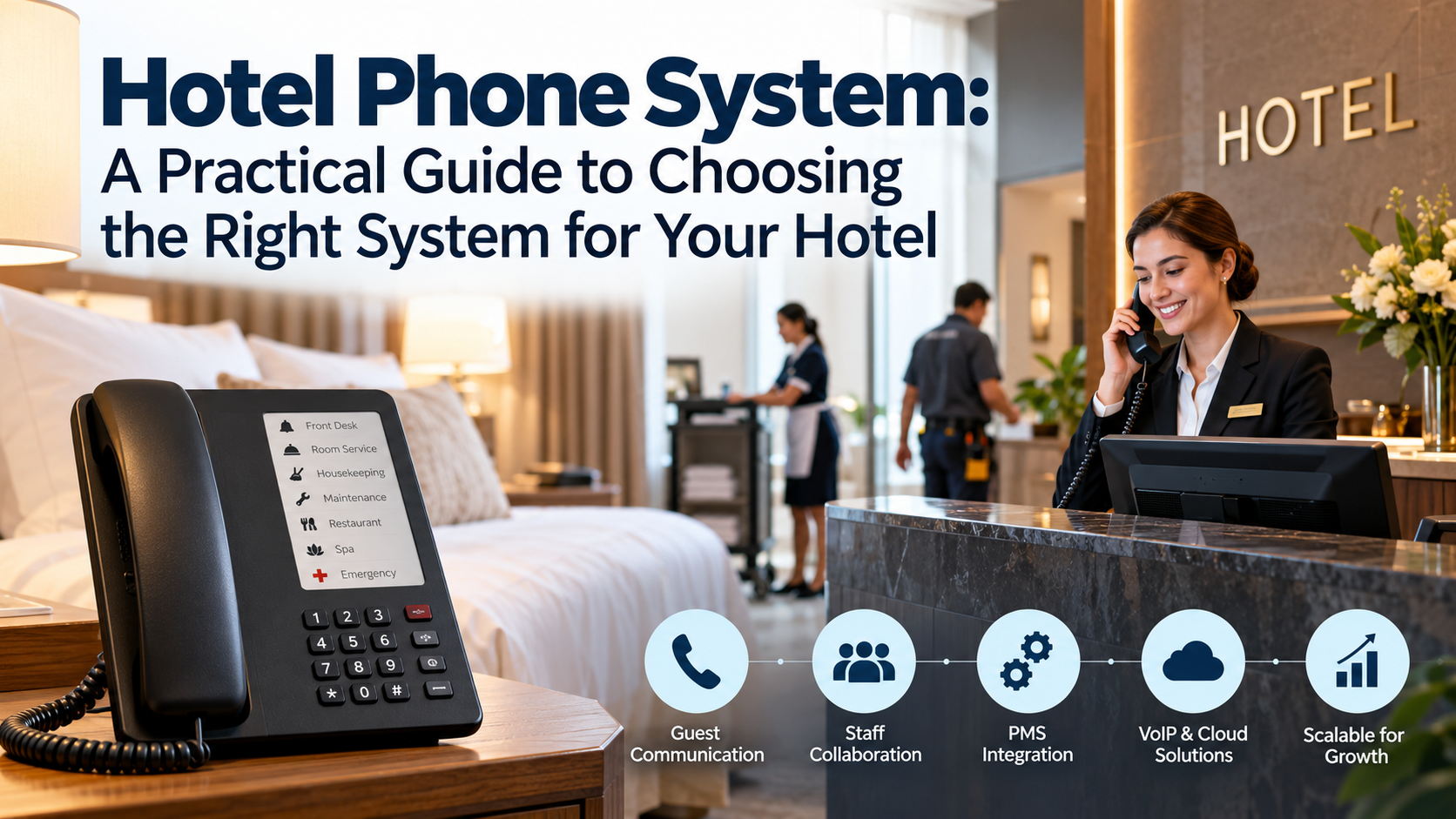
Running a hotel means handling many small requests that can quickly add up. A guest may call for extra towels, the front desk may need to check whether a room is ready, and maintenance may be waiting for an update about a repair. At the same time, reception staff still need to welcome arriving guests and answer outside calls.
That is where a reliable hotel phone systems can make a difference. It gives guests a convenient way to contact hotel services and helps employees communicate with one another without having to search for the right person every time.
For hotels across the United States, choosing a telephone system is about more than buying handsets. The right setup should fit the property's size, existing wiring, staff workflows, property management system (PMS), budget, and plans for future growth.
Whether you manage an independent hotel, a roadside motel, a boutique property, or a large resort, this guide explains what to look for in a modern hotel telephone system, which features deserve attention, and what to ask before signing a contract.
What Is a Hotel Phone System?
A hotel phone system is a communication solution that connects guest-room telephones, reception, administrative offices, and hotel departments. It allows guests to reach the front desk and gives employees a direct way to contact housekeeping, maintenance, management, and other teams.
Unlike a basic office phone setup, a hotel telephone system may need to support room extensions, guest check-in and checkout workflows, voicemail, wake-up calls, call accounting, and integration with a property management system.
For example, a guest can dial reception from their room, while a receptionist can call housekeeping using an internal extension to check room readiness. These calls can be handled through the hotel's telephone network rather than requiring staff to use external numbers for every conversation.
Depending on the property's requirements, a hotel phone system may use a traditional private branch exchange (PBX), an IP PBX, a cloud-hosted VoIP service, or a hybrid configuration.
There is no single best system for every hotel. A smaller property may value simple administration and predictable costs, while a larger hotel may need more extensions, advanced call routing, and integration across several departments or buildings.
Learn more about hotel phone system solutions and the communication options available for hospitality properties.
Why a Reliable Hotel Telephone System Matters
Guests may never think about a hotel's telephone infrastructure when everything works as expected. They notice it when they cannot reach reception, their call is transferred repeatedly, or a request takes longer than it should.
A well-planned hotel phone system cannot replace good service or staff training, but it can make communication more straightforward and consistent.
Make It Easier for Guests to Get Help
Imagine a guest returning to their room late in the evening and discovering that they need an extra blanket. A room telephone gives them a direct way to contact the front desk or the appropriate service team.
When extensions and speed-dial buttons are configured clearly, guests do not have to guess which number to call. This small convenience can make the stay feel more organized and reduce unnecessary effort for both the guest and staff.
Help Departments Coordinate Their Work
Hotel operations depend on timely updates. Housekeeping may need to confirm that a room has been cleaned, maintenance may need to report that a repair is complete, and reception may need that information before assigning the room to an arriving guest.
Internal extension dialing gives employees a direct communication channel. It can reduce the need to walk between departments or rely entirely on personal mobile phones for routine coordination.
Support the Front Desk During Busy Periods
Check-in and checkout times can be demanding. Reception staff may be helping guests in person while answering calls and coordinating requests from other departments.
Features such as call transfer, call forwarding, voicemail, and supported call queues can help the team manage incoming calls more systematically. Before choosing a system, consider what should happen when reception is busy or when a department is unavailable.
Prepare for Growth
A hotel's needs can change as it adds rooms, opens another building, or introduces new services. A scalable system can make it easier to add extensions or update call routing without replacing every part of the communication setup.
Ask providers to explain the practical steps and costs involved in expanding the system, rather than relying on a general claim that it is “scalable.”
Essential Features to Look for in a Hotel Phone System
Not every property needs every available feature. Start with the communication problems your team actually faces, then choose the functions that address them.
Guest-Room Telephone Support
Guest-room phones allow visitors to contact reception and hotel services. Depending on the phone model and system, features may include speed-dial buttons, programmable service keys, voicemail, and room-specific extensions.
When comparing room phones, look at ease of use, durability, cleaning requirements, appearance, compatibility, and how easily replacement units can be obtained.
Front-Desk Call Management
The front desk is often the main communication point for the property. Useful features may include:
- Call transfer: Send a caller to the right department or employee.
- Call forwarding: Route calls to an alternate extension based on configured rules.
- Voicemail: Capture messages when an employee cannot answer.
- Call queues: Organize incoming calls when supported by the platform.
- Conference calling: Connect several participants when a discussion requires it.
- Receptionist console: Help reception staff view extensions and manage calls.
Ask the provider to demonstrate these features using situations your staff encounter, such as transferring a guest to maintenance or routing a call when reception is temporarily unattended.
Internal Extension Dialing
Internal dialing lets staff reach colleagues with short extension numbers. A receptionist might contact housekeeping to confirm room readiness, or maintenance might call the front desk to report that a repair has been completed.
A clear extension plan is especially useful in larger properties. Guest rooms, departments, offices, and shared spaces should be organized in a way that staff can learn and remember.
Property Management System (PMS) Integration
Hotel phone system integration with a property management system can connect telephone operations with room-management workflows. Depending on the systems involved, integration may support room-extension assignment, calling permissions, room status synchronization, or call accounting.
Compatibility should never be assumed. Different telephone platforms and PMS products support different features, and some integrations require extra licensing, gateways, or configuration work.
Before purchasing, confirm the exact software versions, which functions are supported, who will configure the integration, and whether ongoing maintenance is included.
Voicemail and Message Management
Voicemail can help employees manage missed calls and receive messages between shifts. Depending on the solution, messages may be retrieved from a handset or an approved interface.
It is also worth agreeing on a simple process for checking messages and responding to guest requests, so important information does not sit unnoticed in a mailbox.
Call Accounting and Reporting
Call accounting can help hotels review telephone usage and applicable call charges. Depending on the platform, reports may include extension activity, call duration, destinations, and other records.
These reports can support cost reviews and telephone-policy decisions. Access permissions and data-retention settings should be configured to suit the property's privacy and operational requirements.
Emergency Calling Support
Emergency calling deserves particular attention for hotels in the United States. Ask how the proposed system handles emergency calls, location information, and any required notifications to on-site personnel.
Requirements depend on the system design and applicable federal, state, and local rules. Work with a qualified provider to review compliance, test the setup, and check whether changes to room layouts or system configuration affect location information.
Traditional PBX vs. IP PBX vs. VoIP for Hotels
Hotels can choose from several telephone technologies. The right option depends on current infrastructure, desired features, budget, and the property's long-term plans.
Traditional PBX Hotel Phone System
A traditional private branch exchange (PBX) manages internal extensions and outside calls through a dedicated switching system, often using conventional telephone wiring and compatible handsets.
For a hotel with an established system, it may be worth assessing whether the existing equipment can continue to meet operational needs before replacing it.
Potential advantages: existing infrastructure may be reusable, staff may already know the system, and locally managed equipment can provide direct administrative control.
Potential limitations: older equipment may have limited integration options, replacement parts may be harder to find, and upgrades can become costly.
IP PBX Hotel Phone System
An IP PBX manages voice communication over an IP network. Depending on the configuration, it may support IP phones, compatible guest-room phones, softphones, call routing, and integrations with other business systems.
An on-premises IP PBX may suit a hotel that wants IP-based communication while keeping control of its telephone equipment. The property should still plan for network quality, power backup, maintenance, and recovery during an outage.
VoIP Phone System for Hotels
A VoIP phone system for hotels carries voice calls over IP networks rather than relying exclusively on traditional telephone circuits. VoIP may be delivered through on-site equipment, a cloud-hosted service, or a hybrid design.
Depending on the platform, hotels may benefit from flexible call routing, remote administration, voicemail, and supported software integrations.
A cloud-hosted system may reduce the need for certain on-site telephony components, while an on-premises system may offer more local control. Neither option removes the need to plan for network reliability, security, backup power, and emergency calling.
Explore a VoIP phone system for hotels and confirm that the selected platform supports the workflows your property actually uses.
Choosing a Hotel Phone System for Your Property Size
Small Hotels and Motels
Smaller properties often need dependable guest-room calling, front-desk communication, internal extensions, and straightforward administration. Owners should compare room count, existing wiring, hardware, maintenance costs, and access to technical support.
A simple system that staff can manage confidently may be more useful than a complex platform with features the property rarely uses.
Boutique Hotels
Boutique hotels often place a strong emphasis on personalized service and the guest experience. Their telephone setup should make it easy to contact the front desk while fitting the property's practical and design requirements.
Consider phone appearance, clear service buttons, ease of use, and any integration that can simplify room management.
Mid-Size Hotels
Mid-size properties may need more extensions, call routing, reception consoles, voicemail, reporting, and PMS integration. It is worth checking whether the system can accommodate changing staffing levels and future room additions.
Large Hotels and Resorts
Large properties may require multiple reception areas, departmental call groups, centralized administration, and communication across several buildings. A distributed IP PBX or cloud-based architecture may be suitable, depending on the operating model.
At this scale, network design, redundancy, security, emergency calling, and software compatibility deserve particular attention.
How to Choose the Best Hotel Phone System in the USA
1. Work Out How Many Extensions You Need
List the guest rooms, front-desk positions, administrative offices, shared phones, and departments that need telephone access. Then consider planned expansion, additional buildings, or changes to the way the property operates.
This gives providers a more accurate basis for recommending system capacity and preparing a quotation.
2. Check Existing Wiring and Network Equipment
Review telephone wiring, Ethernet cabling, network switches, internet connectivity, and existing handsets. Some properties may be able to reuse parts of the infrastructure, while others may need cabling or network upgrades.
A site assessment can help identify installation requirements before costs are finalized.
3. Compare the Total Cost, Not Just the Initial Price
The purchase price is only one part of the cost. Include hardware, software licensing, installation, PMS integration, support contracts, network upgrades, replacement equipment, and recurring service charges.
Cloud-hosted services may use recurring subscriptions, while on-premises systems may require more upfront spending on equipment and maintenance. Ask for one-time and recurring costs to be listed separately so you can compare quotations fairly.
4. Verify PMS Compatibility
Ask the provider to confirm compatibility with your specific property management system and software version. Request a demonstration of the workflows you need, such as room-extension assignment, calling permissions, or room status synchronization.
Confirm which features are included and which require extra licensing or implementation work.
5. Ask About Support and Outage Planning
Hotels operate beyond standard business hours, so support arrangements matter. Ask about service commitments, support availability, maintenance procedures, backup options, and recovery plans.
For IP and cloud systems, review internet redundancy, network resilience, backup power, and how emergency calling is handled during an outage.
6. Review Security and Compliance
Telephone systems may handle call records, extension details, and administrative information. Look for appropriate access controls, secure administration, software updates, and data-retention settings.
For US properties, review applicable emergency-calling obligations and other relevant requirements with a qualified telecommunications provider.
A Practical Hotel Scenario: When Reception Gets Busy
Consider a typical busy morning. Guests are checking out, new arrivals are asking about early check-in, and housekeeping needs to confirm which rooms are ready. At the same time, a guest calls to report an appliance problem.
Without a clear communication process, reception staff may have to search for the right employee, make repeated calls, or leave the desk to pass on a message. A properly configured hotel phone system gives the receptionist a direct way to contact maintenance through an internal extension and helps housekeeping share room-readiness updates with reception.
The telephone system does not replace room-management software, maintenance tracking, or staff training. It provides a communication channel that supports those processes.
A useful question for hotel managers is: Where does communication slow down during a normal shift? Ask staff which calls are often transferred, which departments are difficult to reach, and what information they need from one another. Use those answers to decide which features are genuinely worth paying for.
This is an illustrative hotel scenario, not a verified customer case study. If you have documented results from a real installation, add the property's approved details and measurable outcomes here to demonstrate first-hand experience.
Common Mistakes to Avoid When Buying a Hotel Telephone System
Choosing an office phone system without checking hotel requirements: Some platforms may not support the guest-room functions or PMS integrations your property needs.
Ignoring existing infrastructure: Incompatible wiring, older equipment, and network limitations can increase installation costs.
Overlooking emergency calling: Confirm how emergency calls and location information are handled in your specific deployment.
Underestimating future capacity: A system designed only for today's requirements may become restrictive when the property expands.
Failing to evaluate support: Limited technical support can create problems when communication faults occur outside normal business hours.
Assuming integrations are included: PMS connectivity and other hospitality functions may require extra hardware, licensing, or implementation work.
Skipping practical testing: Test internal dialing, call transfers, guest-room extensions, supported integrations, and emergency-calling procedures before the system is fully rolled out.
Hotel Phone System Checklist Before You Buy
Use this checklist when comparing providers for your hotel in the United States:
- Confirm the number of guest-room and staff extensions.
- Check compatibility with existing handsets and cabling.
- Verify PMS integration and supported software versions.
- Evaluate internal dialing, call transfer, voicemail, and routing.
- Confirm emergency-calling functionality and applicable requirements.
- Review network reliability, backup power, and recovery plans.
- Compare installation, licensing, subscription, and maintenance costs.
- Check technical support availability and service commitments.
- Plan staff training, testing, and migration from the existing system.
- Confirm expansion options before signing the contract.
Using the same checklist for each provider makes it easier to compare solutions based on your hotel's needs rather than on price alone.
Frequently Asked Questions About Hotel Phone Systems
What is the best phone system for a hotel?
The best hotel phone system depends on property size, infrastructure, budget, integration needs, and support requirements. Traditional PBX, IP PBX, and VoIP solutions can all be suitable in different circumstances.
How much does a hotel phone system cost in the USA?
Costs vary according to the number of rooms and extensions, equipment, licensing, installation, PMS integration, and ongoing support. Request an itemized quotation based on your property's actual requirements.
Is VoIP a good option for hotels?
VoIP can provide flexible IP-based communication, call routing, and supported software integrations. Hotels should also evaluate network quality, backup power, security, redundancy, and emergency-calling support before selecting a solution.
Can a hotel phone system integrate with a PMS?
Some hotel telephone systems integrate with property management software. Available functions may include room-extension assignment, room status synchronization, calling permissions, and call accounting. Confirm compatibility with your specific platform and software version.
Do hotels still need telephones in guest rooms?
The need for guest-room telephones depends on the hotel's operating model, guest expectations, brand standards, and applicable requirements. Room phones can provide convenient access to reception and hotel services without requiring guests to use their personal mobile devices.
Can an IP phone system use existing hotel wiring?
Sometimes. Compatibility depends on the current cabling, telephone equipment, network configuration, and selected system. A site assessment can establish whether the infrastructure can be reused or needs upgrades.
What should hotels consider when replacing an old PBX?
Review equipment condition, support availability, extension capacity, wiring, PMS compatibility, migration costs, emergency calling, and future expansion. Plan testing and migration carefully to minimize disruption to guest and staff communication.
Conclusion: Choose a Hotel Phone System That Fits Your Property
A dependable hotel phone system helps connect guests with hotel services and gives employees a practical way to coordinate daily work. The right setup can support a more organized guest experience, but it should be chosen around the property's real requirements rather than a long list of features.
For hotels across the United States, compare room capacity, existing infrastructure, hospitality software integrations, reliability, security, support, and total cost of ownership before making a decision.
Start by identifying the communication issues your team encounters most often. Then ask potential providers to demonstrate how their systems would handle those situations in your hotel.
Explore hotel phone system solutions to learn more about telephone options for hotels, motels, resorts, and other hospitality properties.
Looking for a hotel telephone solution? Review your property's requirements and speak with a qualified provider to identify a system that fits your operations and long-term plans.