
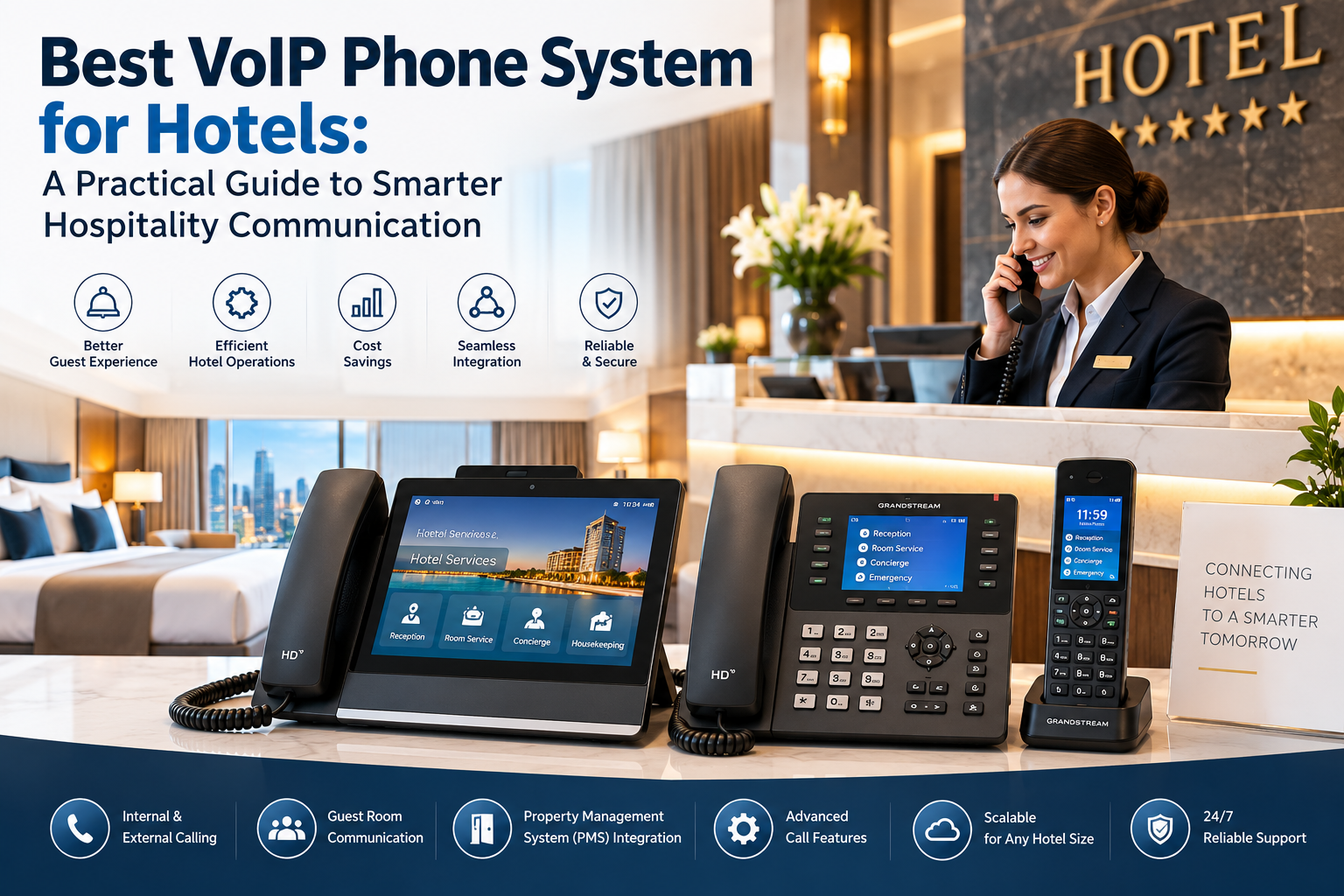
When hotel managers search for the best VoIP phone system for hotels, they are usually looking for much more than a telephone service. They need a communication platform that connects guests, front-desk agents, housekeeping, maintenance, management, and outside callers without making daily operations complicated. A modern hotel VoIP platform can combine cloud calling, extensions, call routing, mobile access, call records, wake-up calls, and continuity features. For properties evaluating a hospitality-focused solution, HospitalityPhoneSystem provides communication options designed around hotels, motels, and lodging operations.
What makes a VoIP system hotel-ready?
A hotel has a communication pattern that is fundamentally different from a conventional office. Calls move between guest rooms and the front desk, departments need fast internal coordination, and staff members frequently work away from fixed desks. The communication platform must therefore support both guest-facing simplicity and behind-the-scenes operational control. A system that works well for a ten-person office may still be poorly suited to a property with dozens or hundreds of rooms.
The best VoIP phone system for a hotel should begin with the property workflow. Think about who answers an incoming call, where that caller may need to go next, which employees are mobile, what happens after business hours, and how communication should continue during an internet or power interruption. These questions are more useful than choosing a system simply because it has a long feature list.
The core capabilities hotel operators should evaluate
1. Front-desk call control
The front desk is often the communication hub of a hotel. Agents answer outside calls, respond to guest requests, transfer callers to departments, and coordinate with managers. The phone interface should make common actions fast: answering, holding, transferring, parking, forwarding, and using frequently called extensions. A complicated interface can slow service during peak check-in periods, so ease of use is a practical requirement rather than a cosmetic preference.
2. Auto attendant and intelligent call routing
An auto attendant can greet callers and guide them to reservations, the front desk, sales, or another department. Routing rules can also support business hours, after-hours behavior, overflow handling, and department ring groups. For a hotel, the objective is to reduce unnecessary manual transfers while keeping callers connected to a real team when they need assistance.
3. Wake-up call functionality
Wake-up calls are a classic hospitality requirement. Guests may depend on them for flights, business meetings, tours, or transportation. Automated wake-up functionality can reduce repetitive work for front-desk employees while providing a consistent guest service. The hotel should define who can create, modify, cancel, and verify wake-up calls and what procedure applies when a guest does not answer.
4. Mobile and wireless communication
Hotel employees do not spend their entire shift behind a desk. Managers walk the property, maintenance teams move between equipment areas, and housekeeping supervisors travel between floors. Mobile applications and wireless endpoints can extend business communication to authorized staff while they are moving. The right device mix depends on the job role, building layout, Wi-Fi or DECT coverage, and security requirements.
5. Call history, logs, recording, and analytics
Call history and logs help managers understand what happened when a call was missed or transferred incorrectly. Call recording can support training and quality review when the hotel has appropriate consent, privacy, and retention policies. Analytics can reveal busy periods and recurring communication patterns. The most useful reports are the ones tied to an operational decision, such as staffing the front desk during high-volume periods or investigating missed calls.
6. Business continuity
A hotel operates 24 hours a day, so continuity planning should be part of the initial phone-system design. LTE backup can provide an alternate connectivity path when the primary internet service is unavailable, subject to configuration and carrier coverage. UPS battery backup can protect selected equipment during power interruptions. Real-time alerts and a documented support process can further reduce response time when a problem occurs.
Why cloud PBX matters for hospitality
Cloud PBX places call-control functions in a hosted environment and can simplify centralized management. Authorized administrators may be able to add extensions, adjust routing, manage users, and review communication activity without physically visiting every phone location. This is particularly useful for hotels with changing staffing requirements or multiple properties.
Cloud architecture does not remove the need for good network planning. Voice quality still depends on the internet connection, local network, power, endpoint configuration, and appropriate monitoring. A strong deployment therefore combines cloud flexibility with practical network and continuity planning.
For a closer look at hospitality-oriented features, review the Hotel VoIP Phone System page, including call routing, wake-up calls, mobile access, alerts, LTE backup, UPS support, and other communication capabilities.
How VoIP improves the guest journey
Guests may interact with the hotel phone system several times during one stay. They may call the front desk for extra towels, request transportation, contact room service, ask about amenities, or schedule a wake-up call. Each interaction is small, but the combined experience influences how convenient the property feels.
A well-designed system reduces friction at these touchpoints. Clear extensions help guests reach the correct service. Fast transfers help front-desk agents avoid unnecessary callbacks. Wake-up automation supports predictable guest routines. Call records help managers identify missed communication. Mobile access can help employees respond without returning to a fixed desk.
A property-level evaluation framework
Start with a communication inventory. Document the number of rooms, departments, employees who need extensions, guest-service numbers, outside numbers, current PBX hardware, analog devices, internet circuits, and backup equipment. Then draw the most common call paths. This creates a clear baseline for comparing vendors.
Curious what a hospitality-ready VoIP system can include?
Take a closer look at the Hotel VoIP Phone System solution and compare its hospitality-focused capabilities with your own property requirements.
Implementation considerations
A successful installation begins before the phones are connected. Review network capacity, cabling, switching, internet reliability, Wi-Fi coverage, power protection, and endpoint locations. If the property has an existing PBX or analog devices, determine which components can be retained and which should be replaced. A phased migration can reduce disruption when compatibility allows.
Training should be treated as part of implementation. Front-desk employees should practice transfers, hold, parking, forwarding, voicemail, wake-up calls, and escalation procedures. Managers should learn reporting and administration. Mobile employees should receive simple instructions for making and receiving authorized business calls. Everyone should know the support contact and basic outage procedure.
Questions to ask before choosing a provider
Final perspective
The best VoIP phone system for hotels is the platform that matches the property's communication workflows, reliability requirements, guest-service model, and growth plans. Features such as auto attendant, call routing, wake-up calls, call history, mobile access, analytics, LTE backup, and UPS support can create a strong operational foundation when properly designed and configured. HospitalityPhoneSystem offers hospitality-focused communication options for properties evaluating modern hotel telephony.
Ready to continue your research? Visit the Hotel VoIP Phone System page and map its capabilities to your hotel's guest-service and operational requirements.
Hotels can use communication data to understand operational pressure. Useful metrics may include inbound call volume, missed calls, average handling patterns, departmental call distribution, and the frequency of transfers. Metrics should be interpreted in context. A high call volume may simply reflect a successful property, while a high missed-call rate may indicate a staffing or routing problem. The goal is not to chase a number but to identify where communication creates friction for guests or employees.
Managers can also compare communication patterns before and after a system change. If the property introduces an automated attendant, mobile calling, or a revised department routing structure, call records can help determine whether the new workflow reduces unnecessary transfers. This creates a practical feedback loop between technology and hotel operations.
Hotel communication planning should also consider the difference between guest-facing and staff-facing calls. Guest-facing calls should be simple, predictable, and easy to complete from a room or public area. Staff-facing calls may require faster transfers, group ringing, escalation, and mobile access. Separating these use cases during the design stage helps administrators create sensible permissions and call flows. It also makes training easier because employees can learn the features that match their roles instead of memorizing every function available on the platform.
Another important consideration is the relationship between communication and service recovery. A missed call can become a guest complaint if nobody follows up. A call that reaches the wrong department can create multiple transfers and increase wait time. A broken extension can make a guest believe the hotel is unavailable. Call history, alerts, routing rules, and clear ownership can help turn these communication failures into manageable operational events. The technology should support a defined service-recovery process rather than simply recording that a call occurred.
Hotels should also document seasonal changes. A property may have different call volumes during holidays, conferences, wedding events, tourist seasons, or corporate travel periods. The phone system can be configured with different schedules and routing behavior when supported. Managers should identify which periods create the highest communication demand and test the call flows before those periods begin. This is especially useful for independent hotels where a small team may handle a large temporary increase in guest calls.
Hardware selection deserves attention because the endpoint is the part employees and guests physically interact with. The front desk may need a phone with multiple programmable keys and a clear display, while guest rooms may require a simpler interface. Wireless users need dependable coverage and battery management. The goal is not to make every endpoint identical; it is to make every endpoint appropriate for the job it performs while keeping the underlying communication system consistent.
Finally, hotel managers should document ownership. Someone should be responsible for extensions, someone for network coordination, someone for support escalation, and someone for reviewing communication reports. Clear ownership prevents small configuration problems from becoming long-running service issues. A modern VoIP platform provides tools, but operational discipline determines whether those tools deliver consistent value.
Hotel communication: from feature selection to daily performance
A hotel should judge its phone system by what happens during real operating conditions. During a quiet afternoon, almost any properly configured system may appear adequate. The more useful test is a busy check-in period, a simultaneous department request, an outside reservation call, and a guest needing assistance at the same time. These situations reveal whether routing rules are logical, whether employees can transfer calls quickly, and whether mobile staff can be reached without unnecessary steps. The system should be designed around these peak moments because that is when communication quality has the greatest effect on guest service.
The property should also define what happens when nobody answers. Every important department needs a clear overflow path. A reservation call might move to another trained employee, a maintenance request might reach a supervisor, and a front-desk call might return to a shared ring group. Without these rules, a sophisticated phone system can still produce missed calls. Call forwarding, ring groups, voicemail, and alerts are most valuable when they are connected to an agreed operational process.
Hotel managers should consider the relationship between fixed phones and mobile communication. Fixed phones remain useful for guest rooms and front desks because they are familiar and always located in a known place. Mobile or wireless devices are useful for employees who move. The goal is not to replace one type of device with another; it is to create a coordinated environment where each device supports the job it was selected for. A well-designed extension plan can make calls move between these endpoints without forcing employees to learn separate systems.
The system should also support change. A hotel may add a new restaurant, rename a department, change operating hours, open a meeting area, or temporarily add staff for an event. Administrators should be able to update relevant users, greetings, routing rules, and permissions without rebuilding the entire platform. This is one reason centralized management can be valuable for hospitality businesses. It turns communication configuration into an administrative task rather than a hardware project every time a small change occurs.
Finally, the provider relationship matters after installation. Hotel communication is an ongoing service, not a one-time purchase. Managers should know how to report faults, request configuration changes, replace devices, and escalate issues. The provider should also be clear about what the property is responsible for, including local network conditions, power, internet service, and endpoint placement. Clear responsibility prevents confusion when a problem crosses the boundary between the phone platform and the hotel's own infrastructure.