
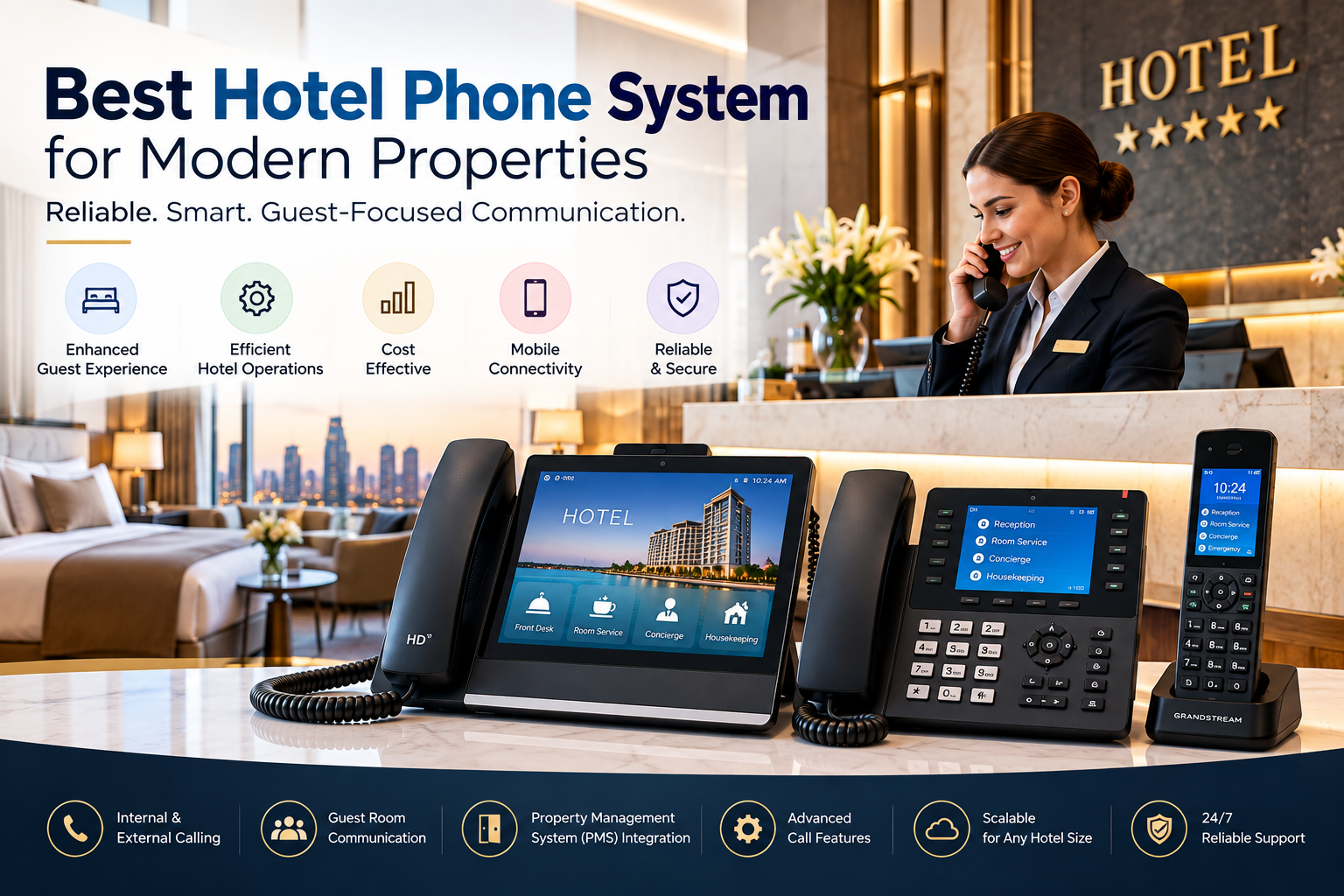
A hotel phone system touches nearly every department in a property. Guests use it to contact reception, staff use it to coordinate service, managers use it to stay connected, and outside callers use it to reach reservations or other departments. Selecting the best hotel phone system therefore requires an understanding of the guest journey as well as the hotel's internal workflow. HospitalityPhoneSystem offers communication solutions for hotels and lodging businesses that can support these different requirements.
A hotel day begins before check-in
Hotel communication starts long before most guests arrive. Early-morning wake-up calls, airport transfers, housekeeping schedules, maintenance requests, and reservation inquiries all create communication activity. The phone system has to support these interactions without requiring employees to manage every step manually.
This is one reason hospitality communication should be designed around routines. When the most common tasks have clear call paths, employees spend less time deciding how to route a request and more time responding to it.
Morning: wake-up calls and early departures
Wake-up calls remain a useful hotel service because they connect directly to a guest's schedule. A traveler may have a flight, business meeting, tour, or early appointment. An automated wake-up feature can help the front desk manage scheduled calls consistently.
The same communication environment can handle guest questions that follow a wake-up call. A guest may call reception for transportation information or ask for assistance before leaving the property. Fast access to the front desk is therefore just as important as the scheduled service itself.
Midday: the property becomes a network of departments
During the day, housekeeping, maintenance, reservations, management, food and beverage teams, and front-office staff communicate continuously. A room that needs attention may require coordination between reception and maintenance. A housekeeping supervisor may need to contact the front desk about room status. A manager may need to reach several departments quickly.
A modern phone platform can organize these interactions through extensions, department groups, call transfer, call forwarding, and mobile communication. Instead of treating every department as an isolated telephone endpoint, the system can create a connected internal environment.
Afternoon: outside calls and reservation activity
External callers may be looking for reservations, event information, group accommodation, directions, or a specific employee. An auto attendant can provide callers with a clear path to the appropriate department. Call routing can also be configured around working hours and after-hours requirements.
For hotels with high call volume, these functions can reduce the pressure on the front desk. Employees can focus on guests standing at reception while routine inbound calls are directed to the appropriate team.
Evening: peak guest interaction
Evening is often one of the busiest periods for guest communication. Travelers are checking in, restaurants are active, guests are requesting amenities, and families may need assistance with rooms or property services.
At this point, the value of a well-organized call system becomes visible. Ring groups can distribute calls. Transfers can move conversations to the right department. Mobile communication can help managers and supervisors respond without returning to a fixed desk.
Night: communication cannot simply stop
Hotels operate continuously. A communication system that works well during the day must also support overnight operations. Staff levels may be lower, but guest needs do not disappear. A late-night maintenance request, emergency situation, or transportation question still requires an appropriate response.
Backup connectivity and protected power can become especially important during these hours. LTE backup, UPS battery support, monitoring, and defined technical support procedures can help a property prepare for interruptions.
What belongs in a modern hotel phone system?
- Guest-room extensions that provide straightforward access to the front desk.
- Auto attendant and call-routing functions for outside callers.
- Call transfer, forwarding, and ring groups for department coordination.
- Wake-up calling for scheduled guest services.
- Call history and logs for follow-up and operational visibility.
- Mobile communication for authorized managers and staff.
- SMS or other integrated communication tools where useful.
- Call recording and analytics when appropriate policies and requirements are in place.
- Emergency calling capabilities configured for the property's location and applicable requirements.
- Backup connectivity and power protection for continuity planning.
The guest experience depends on the internal experience
Guests rarely see the internal communication process, but they experience its results. If a front-desk employee cannot reach housekeeping quickly, the guest may wait longer. If a maintenance request is passed between several employees without a clear owner, the guest may have to call again.
A connected communication system helps reduce these gaps. It gives employees predictable ways to reach departments and provides managers with tools for understanding where communication is working and where it may be breaking down.
For properties looking at a hospitality-specific platform, the Hotel VoIP Phone System page describes features such as auto attendant, call history, wake-up calls, mobile access, alerts, LTE backup, and professional support.
Choosing the right phones for the property
The hotel phone system is more than its software. The physical devices also influence how employees interact with the system. Front-desk staff may need multiple line appearances and programmable buttons. Guest rooms may require simple and durable phones. Managers may prefer mobile access. Employees working across large properties may need wireless devices.
Device selection should follow the workflow. Start with the job role, then identify the communication functions that role requires. This produces a more useful deployment than installing identical devices everywhere.
Cloud, PBX, and hybrid communication
Hotels can use different architectures depending on their existing infrastructure and goals. A cloud-based platform can provide centralized management and flexible access. An on-premise or enterprise PBX can provide structured call control within the property. Some properties may use a hybrid design that combines modern VoIP services with existing equipment.
The important question is how the architecture supports the hotel's daily operations. A property with legacy devices may prioritize compatibility. A new hotel may design its network around IP communication from the beginning. A multi-property group may place greater emphasis on centralized management.
Network and power planning
VoIP depends on the infrastructure beneath it. Internet reliability, switches, cabling, Wi-Fi coverage, traffic management, and power protection all matter. Before installation, the hotel should understand where voice endpoints will be placed and how traffic will travel through the property.
Wireless coverage deserves special attention. A mobile or Wi-Fi phone is only useful where the network provides consistent coverage. Testing should include back-of-house areas and service corridors, not only guest-facing spaces.
A controlled installation creates a better transition
Replacing a hotel phone system can affect every department, so the transition should be planned carefully. Document current numbers and extensions, create the new call flows, configure devices, test critical scenarios, and train employees before the final cutover.
Testing should include normal and after-hours calls, transfers, guest-room extensions, wake-up calls, mobile users, voicemail, and backup procedures. Any failure discovered during testing is an opportunity to fix the design before guests depend on it.
Curious what a complete hotel communication platform can support?
Visit the Hotel VoIP Phone System page to explore a hospitality-focused communication environment and the functions that can support guest service and hotel operations.
Managing communication after installation
A phone system should be reviewed after it goes live. Managers can monitor missed calls, extension changes, unusual call patterns, and recurring service issues. If a department consistently receives calls that should go elsewhere, the routing structure may need adjustment.
Regular reviews are particularly useful after renovations, staffing changes, new services, or property expansion. The communication system should evolve with the hotel rather than remain fixed to the conditions that existed on installation day.
Conclusion
The best hotel phone system supports the property throughout the entire day: from early wake-up calls and reservation inquiries to evening guest requests and overnight service. It should connect guests with the right people, help employees coordinate quickly, and give managers the tools needed to maintain reliable communication. HospitalityPhoneSystem offers hospitality-focused phone and communication solutions that can be evaluated according to the size, layout, and operating model of each property.
Hotels ready to examine the technology in more detail can explore the Hotel VoIP Phone System page for additional information about hospitality communication capabilities.
Small properties have different priorities
An independent hotel or boutique property may not need the same communication architecture as a large resort. Its priorities may be simplicity, dependable guest-room calling, an efficient front desk, and manageable costs. A smaller property can still benefit from modern VoIP features without deploying every advanced function available. The right design should match the number of employees, rooms, departments, and communication paths that actually exist.
Larger properties require more coordination
As properties become larger, communication paths multiply. A resort may have several buildings, restaurants, conference facilities, recreation areas, engineering teams, and multiple front-office functions. Department groups and centralized call management become increasingly important. Wireless and mobile communication may also become more valuable because employees can spend much of their shifts away from fixed desks.
Guest rooms and public areas
The communication plan should cover more than guest bedrooms. Conference rooms, lobby areas, back offices, staff entrances, pool areas, restaurants, and other operational spaces may require communication endpoints. The placement of devices should be based on how employees and guests use each area. Wireless communication can be useful where fixed phones would restrict movement.
Reducing repeated conversations
Good call routing can reduce the number of times a guest has to explain the same request. If reception can quickly connect a caller with the department responsible for the issue, the guest can receive a more direct response. Internal extensions and transfers also help employees avoid asking another person to call a third person simply to locate the right department.
Measuring service improvements
Once the system is operating, managers can compare practical indicators such as missed calls, response patterns, peak calling periods, and recurring transfer requirements. These observations can lead to changes in staffing, routing, or training. The communication system becomes more useful when the hotel treats its information as an operational resource rather than simply as a telephone service.
Boutique hotels and personalized service
Smaller hotels often compete through personal service, which makes communication especially important. A guest may expect to speak directly with someone who knows the property. A simple, reliable system can support that personal approach by making it easy for a small team to share calls and respond quickly without creating unnecessary layers of automation.
Resorts and complex properties
Resorts can have a much broader communication footprint. Guests may move between accommodation buildings, restaurants, conference spaces, recreation facilities, and outdoor areas. Employees also move across these spaces. Wireless communication and thoughtful routing can help maintain connectivity without requiring every employee to remain near a desk.
Seasonal demand
Some hotels experience large changes in occupancy throughout the year. Communication requirements may increase during holidays, events, or tourism seasons. A flexible system can help properties adapt staffing and routing as demand changes, rather than requiring permanent infrastructure for the highest possible call volume at all times.
Communication should match the hotel's service promise
A luxury property may want a highly personalized communication experience, while a limited-service hotel may prioritize speed and simplicity. Both can use modern VoIP, but the configuration should reflect the service model. The system should support the way employees are expected to interact with guests rather than imposing a generic workflow.
A reliable foundation for future services
As hotels introduce new digital services, the phone system can remain an important communication channel. Mobile applications, messaging, analytics, and other integrations can be added when they provide clear value. A flexible architecture gives the property more room to adapt without rebuilding its communication foundation each time a new service is introduced.
The value of consistent call handling
Consistent call handling helps create a predictable experience. Guests should not receive completely different responses depending on which employee answers. Clear routing, department responsibilities, and staff training give employees a shared framework while still allowing them to provide personal service.
Handling peak occupancy periods
During high occupancy periods, communication demand can increase quickly. More guests create more front-desk questions, department calls, and service requests. Hotels can prepare by reviewing call routing, staffing, and overflow procedures before peak periods begin. This allows the communication system to support the operation when demand is highest.